
Inaugural Signature Event of the Master of Arts in Law Enforcement Executive Leadership Program
Tuesday, June 9, 2026
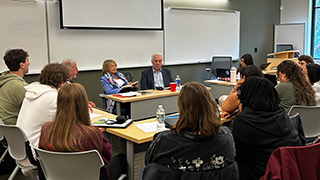
 On Friday, April 24, 2026, Seton Hall University’s College of Human Development, Culture, and Media proudly hosted the inaugural signature event of its Master of Arts in Law Enforcement Executive Leadership (LEEL) program: "Amplifying Voices, Breaking Multiple Barriers: A Conversation with Women
Leaders in Criminal Justice."
On Friday, April 24, 2026, Seton Hall University’s College of Human Development, Culture, and Media proudly hosted the inaugural signature event of its Master of Arts in Law Enforcement Executive Leadership (LEEL) program: "Amplifying Voices, Breaking Multiple Barriers: A Conversation with Women
Leaders in Criminal Justice."
The event, convened in the University Center Event Lounge, was envisioned and hosted by Program director Kishon C. Hickman, Sr., Ph.D., in partnership with Acting Department Chair Rong Chen, Ph.D. The evening brought together executive practitioners, scholars, students, alumni and University leadership for a substantive dialogue on women’s leadership in the American criminal justice profession.
 The evening’s intellectual and inspirational tone was set by keynote speaker Tracie
L. Keesee, Ph.D., a globally recognized scholar-practitioner, co-founder of the Center
for Policing Equity and former deputy commissioner of the NYPD. Serving as the program’s
Vanguard Voice, Keesee anchored the conversation in the lived realities of women who
have led and continue to lead at the highest levels of policing, public safety and
justice reform. Her address reminded attendees that some of the most consequential
leadership of this generation has emerged from the voices of women in the profession.
The evening’s intellectual and inspirational tone was set by keynote speaker Tracie
L. Keesee, Ph.D., a globally recognized scholar-practitioner, co-founder of the Center
for Policing Equity and former deputy commissioner of the NYPD. Serving as the program’s
Vanguard Voice, Keesee anchored the conversation in the lived realities of women who
have led and continue to lead at the highest levels of policing, public safety and
justice reform. Her address reminded attendees that some of the most consequential
leadership of this generation has emerged from the voices of women in the profession.
The panel discussion that followed was guided by moderator Shantae Coppock, Ph.D., LEEL adjunct faculty, whose warmth and command of the conversation gave the evening its steady rhythm. Panelist introductions were delivered by Jonnese Arrington, Ed.D., LEEL faculty, whose graceful and scholarly presentation set the stage for each panelist’s contribution with the rigor that has come to define the LEEL Program.
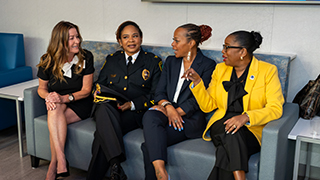
The featured panel reflected the breadth of women’s leadership across the modern criminal justice landscape. Chief Kim Y. Royster (retired), former bureau chief of the NYPD Transportation Bureau, offered insights drawn from a distinguished career spent advancing within one of the nation’s largest law enforcement agencies. Chief of Police Niheema Malloy of the Maplewood Police Department, a proud LEEL Class of 2017 graduate, spoke to the path from doctoral aspiration to executive command. Cara A. Parmigiani, Esquire, a Seton Hall University School of Law alumna, brought the perspective of the legal profession. Lieutenant Bridget Lawrence (retired), Seton Hall University adjunct faculty, contributed the wisdom of decades spent in the field and the classroom. And Gineen Gray, M.A., former deputy commissioner of the NYC Department of Probation, illuminated the often-overlooked terrain of correctional leadership and reform.
Together, the panelists offered a multidisciplinary perspective on leadership, the navigation of institutional barriers, the discipline of mentorship and the future of equitable justice — closing with a single, animating question posed to every participant in the room: “What do you do with your voice?”
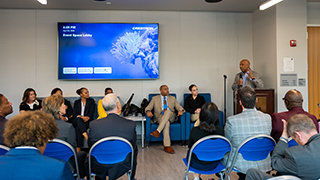
The evening drew distinguished representation from across the law enforcement, public safety, education, and legal sectors. Among those in attendance were President Jiles Ship, commissioner of the New Jersey Police Training Commission, NOBLE New Jersey president and a proud LEEL Class of 2002 graduate; Superintendent Jeanne Hengemuhle of the New Jersey State Police; Damon Brooks, retired NYPD captain and professor at CUNY Bronx; and Stephen Hoptay, Ed.D., founding chairperson of the LEEL Program Advisory Board, whose steady belief planted the seeds from which this program has grown. The room further included senior leadership representing the NYPD, the New York State Office of the Attorney General, the Newark Police Department, the Maplewood Police Department, NOBLE New Jersey, and Seton Hall University’s senior academic community.
 Reflecting on the evening, Hickman observed,
This program was conceived as more than a panel but a posture — a declaration that the future of executive leadership in criminal justice will not be written without the voices of the women who have built and rebuilt this profession from the inside. To stand in that room surrounded by the very leaders whose careers our students aspire to emulate was to witness Seton Hall University and the LEEL Program doing precisely what we were built to do: convene scholarship and practice, honor those who came before, and prepare those who come next.
Categories: Faith and Service, Law