
Bishop Saporito Examines St. Paul's Hospitable Communication
Thursday, December 11, 2025
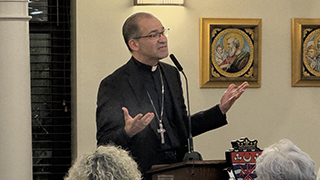
Bishop Saporito speaking at ICSST
On November 5, 2025, Immaculate Conception Seminary School of Theology (ICSST) hosted Bishop Michael A. Saporito, D.D., Auxiliary Bishop of Newark, New Jersey, as part of its Many Faces of Hospitality series sponsored by the Preaching as Hospitality Formation Program. An ICSST alumnus, Bishop Saporito has served on the Evangelization Commission of the Archdiocese of Newark and on the board for the Christlife Evangelization Apostolate of the Archdiocese of Baltimore.
Bishop Saporito’s talk, “St. Paul the Evangelizer,” was preceded by light refreshments and fellowship in the Seminary refectory. The event was attended by 83 people, including faculty, students, seminarians, St. Paul’s Outreach missionaries, alumni and local parishioners.
With enthusiastic flair, Bishop Saporito unpacked St. Paul’s Letter to the Romans: “But how are they to call on one in whom they have not believed? And how are they to believe in one of whom they have never heard? And how are they to hear without someone to proclaim him? And how are they to proclaim him unless they are sent? As it is written, ‘How beautiful are the feet of those who bring good news!’” (Rom 10:14-15).
Analyzing how St. Paul’s communication style was essential for preaching the Word of God, Bishop Saporito emphasized how we can model his example in our own hospitable preaching. “Words have power,” Bishop Saporito said. “Words can move our hearts to prayer, to action, to new hope, to encouragement, to comfort and to challenge.”
According to Bishop Saporito, the structure of St. Paul’s letters was key to conveying his hospitable message, and all of them began with a greeting. St. Paul’s personal greetings were both an acknowledgement of his audience and an invitation for the audience to receive his preaching. Citing examples from his time as a pastor, Bishop Saporito stressed the importance of greetings and their impact on listeners. “Such things open the heart of those who may have rushed to be present,” he explained. “What it does is it prepares the way for your message to be heard. It’s kind of like, ‘Let’s take a breath.’”
St. Paul used cultural empathy to connect with his audience. He understood his communities, acknowledged their sufferings and contexts, and communicated his own struggles. This allowed him to bring his preaching down to a personal level that reached his listeners more effectively and honestly. Bishop Saporito emphasized: “He was living with what he was preaching…I will never say something to a congregation and challenge a congregation to a challenge that I myself won’t be willing to take. That’s fake, and I can’t be fake.” Illustrating many examples from his own preaching, Bishop Saporito showed how authentic and engaging storytelling helps connect with listeners and invite them to hear the Good News of Jesus Christ.
Bishop Saporito concluded by reaffirming St. Paul’s position as the Church’s most prolific preacher and reminding us to preach and communicate in ways that invite others into the message of Christ so that they may hear a transformative and hospitable message.
“I really enjoyed Bishop Saparito’s enthusiasm; he was very inspirational and captivating,” praised one attendee.
The Preaching as Hospitality Formation program of Immaculate Conception Seminary School of Theology seeks to form seminarians, diaconal students, and religious and lay graduate students of theology to be compelling preachers who will offer a hospitality of the heart as they break open the Word of God. The initiatives help to form preachers who will understand and embrace preaching as hospitality — a ministry of inviting, welcoming and offering compassion. The program also focuses on newly ordained priests and deacons and newly appointed pastors (less than five years) who are invited to re-imagine their preaching through the lens of Christian hospitality.
To learn more about Many Faces of Hospitality, or ICSST’s Preaching as Hospitality Formation Program, please contact Alyssa Carolan at ([email protected]).
Categories: Faith and Service